
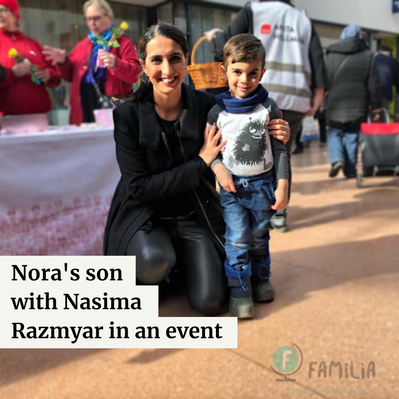
 Rasismi ja syrjintä ovat olleet tämän rasisminvastaisen viikon keskeisiä puheen aiheita. Familian 16.3. järjestämässä Antirasismi Workshopissa keskusteltiin ennakkoluuloista ja siitä, miten toimin kohdatessani rasismia tai syrjintää. Keskusteluun osallistui joukko naisia, joista suurin osa äitejä. Miesten poissaolo herätti ihmetystä, eikö aihe kiinnosta miehiä ja isejä? Lasten kohtaama rasismi ja syrjintä koskettaa koko perhettä. Jokaisen perheenjäsenen kokemukset ovat erilaisia ja siksi niistä puhuminen voi tuntua vaikealta, mutta on tärkeä pystyä puhumaan ja jakamaan omat kokemukset ja erityisesti ne tunteet mitä rasismin ja syrjinnän kokemukset herättävät. Ymmärrys siitä, että jokaisen oma kokemus on yksilöllinen, mutta tärkeä, auttaa puheeksi ottamisessa lasten kanssa. Keskustelun avaaminen ja sen käyminen on siksi ensiarvoisen tärkeää. Ei pidä ajatella, ettei toinen ymmärrä, vaan auttaa toista ymmärtämään miltä itsestä tuntuu. Keskusteluun pitää saada mukaan kaikkien ääni, jotta ymmärrystä ja oppimista suuntaan ja toiseen tapahtuu. Kukaan ei saa pelätä osallistumista ja omien ajatustensa esille tuomista. Jokaisen kokemus on erilainen, koska siihen vaikuttaa jokaisen oma kulttuurinen kompetenssi eli tausta, kasvatus ja aikaisemmat kokemukset. Esimerkiksi suomalaisessa kulttuurissa on aika tyypillistä pyrkiä välttelemään mahdollisia konflikteja ja olla ottamatta kovin voimakkaasti kantaa asioihin. Mutta jokaisen kokemus on yhtä tärkeä ja opettava jaettavaksi. Dialogin avaaminen aiheesta on avain oppimiseen. Tärkeä osa oppimista on myös oman etuoikeuden tunnistaminen ja tiedostaminen. Sen olemassaolon havaitseminen usein yllättää. Erityisesti kun on kyse kahden kulttuurin perheistä, joissa perheenjäsenten roolit ulkopuolisten ja yhteiskunnan silmissä ovat hyvin erilaiset puhuttaessa etuoikeudesta. Erityisesti omien lasten kohdalla on vaikea hyväksyä perheen jäsenten eriarvoisuus yhteiskunnan silmissä. Vaikka valkoiset eivät itse Suomessa suoranaista rasismia kokisikaan, he voivat olla "allyja" eli liittolaisia sitä täällä kokeville. Oma kokemus voi perustua välilliseen rasismin tai syrjinnän kokemukseen oman perheen tai läheisen kautta. Kokemuksen ja siihen liittyvät tunteet voi jakaa, vaikka itse ei olisikaan asiantuntija tai vähemmistöryhmään kuuluva. Selkeä yhteinen nimittäjä ”Antirasismi workshop” keskusteluun osallistuneilla naisilla oli äitiys ja lapsiin kohdistuvat rasismin ja syrjinnän kokemukset. Näiden jaettujen kokemusten kautta onkin hyvä miettiä, onko tärkeämpää keskittyä meissä oleviin eroihin vai meitä yhdistäviin ominaisuuksiin kuten äitiys ja jokaisen äidin halu pitää lapsensa turvassa ja varjella heitä ympäröivältä pahalta. Familia jatkaa aiheen parissa työskentelyä antirasismihankkeessaan ja järjestää myös tulevaisuudessa mahdollisuuden avoimelle keskustelulle, jossa on tilaa jokaiselle kahden kulttuurin perheenjäsenen äänelle. Antirasismihankkeen tiimin puolesta Anu Kytömäki, monikulttuurisen perheen etuoikeutettu äiti ja puoliso Racism and discrimination have been at the key topics of discussion of the week against racism. 16th of March Familia organized The Anti-Racism Workshop to discuss prejudice and how I act when faced with racism or discrimination. Group of women, most of them mothers, took part in the debate. The men's absence caused wonderment, aren't men and fathers interested in the subject?
The racism and discrimination faced by children affects the whole family. The experiences of each family member are different and therefore talking about them can seem difficult, but it is important to be able to talk and share your own experiences and especially the emotions aroused by the experiences of racism and discrimination. Understanding that everyone's own experience is individual, but important, help to bring up the topic with children. Opening and running a debate is therefore of paramount. You should not think someone does not understand. Instead, you should help that someone to understand how you feel. You must hear everyone's voice in the conversation, to ensure understanding and learning in one direction and another. No one should be afraid to participate and to express their own ideas. Everyone’s experience is different, because it is influenced by everyone's own cultural competence i.e., the background, education, and past experience. In Finnish culture, for example, it is quite typical to try to avoid potential conflicts and not to take a very strong stand on things. But everyone's experience is just as important and educational to share. Opening a dialog on the topic is the key to learning. An important part of learning is also the identification and awareness of one's own privilege. Detecting it existence often surprises. Especially when it comes to intercultural families, where the roles of family members in the eyes of outsiders and society are very different when it comes to privilege. Especially for your own children, it is difficult to accept inequality among family members in the eyes of society. Even if white people in Finland themselves do not experience outright racism, they can be allies, for those who experience it here. Own experience may be based on indirect experience of racism or discrimination through your own family member or loved one. Experience and related emotions can be shared, even if you are not an expert or a member of a minority group. Clear common denominator in Anti racism workshop women who participated in the debate had maternity and experiences of racism and discrimination against children. It is a good idea to think about these shares of experience, whether it is more important to focus on the differences in us or on the qualities that unite us, such as motherhood and every mother's desire to keep their children safe and protect them from the evil that surrounds them. Familia continues to work on the topic in its anti-racism project and will also provide an opportunity for open discussion in the future, with room for each voice of a family member of two cultures. On behalf of the Anti-Racism Project team Anu Kytömäki, privileged mother and spouse of a multicultural family
0 Comments
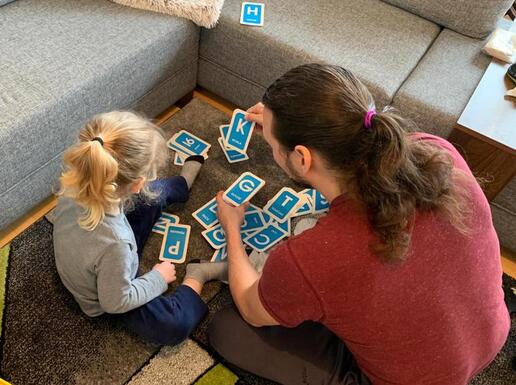 Gabriel and Tristan Herrera My son was born in Tampere almost 40 years ago. At the time, we used English with my Finnish ex wife as an unavoidable lingua franca. But from the very first day at home, we both decided to systematically speak our own native languages when talking to the baby. This meant that I started using exclusively Spanish in all my interactions with the boy. It was not always easy to keep up. The Finnish environment (mother, neighbourhood, day-care, shops, TV, etc.) was pervasively ubiquitous and the child grew understandably more familiar with that language. Meanwhile — as my own language skills slowly improved — it became often tempting to just give up and give in. I stubbornly resisted and, with time, my son and I both started gradually to resort with reasonable effectiveness to Spanish in our bilateral relations. I did not quite realize it then, but an anecdote can perhaps illustrate a collateral and unintended phenomenon that emerged: when he was about four years old, we went by car on a family vacation all the way to Spain. We drove into that country coming from France quite early one morning and soon stopped at a road-side cafeteria in order to have breakfast. My son had been sleeping when we arrived. But he rapidly woke-up and, like children often do, started to explore the place, independently walking among the tables (which were more or less full with customers) while we studied the menu options. Only a few moments later, he came rushing back to us and, wide eyed and obviously bewildered, told me: “dad, everyone here speaks like you...” It dawned on me then that he had grown actually convinced that Spanish was a sort of “secret language”, to be utilized only between us two. The sudden discovery that there were other people (indeed, other world) who also communicated like that, must have been quite a shock. Subsequently, he continued to improve steadily with his Spanish over the years, eventually adding also other languages, apparently with enviable ease. Today, he manages well in five languages, and this has been rather useful in his international professional career. In fact, the positive empirical experience gained with him as a child, was applied successfully by us subsequently with his younger sister. She now speaks fluently several languages as well and has also found it equally advantageous from the professional and social point of view.
In conclusion, I strongly suggest that parents with mother tongues different to Finnish should make deliberate efforts to preserve them, when communicating with their children. Of course, this has to be made systematically, stubbornly, and with lots of patience. I assure you, results can be highly rewarding indeed for all involved. Luis Herrera 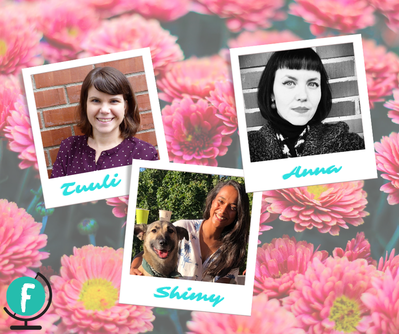 Today is Zero Discrimination Day. The United Nations and other international organisations remember this day annually on 1st of March. Most of the political and international movements in the last century or more have been in some way inspired by the idea of vanquishing a type or more of historical discrimination. I have been lucky to have met three people who have anti-discrimination on top of their list. And lucky for Familia they are part of our wonderful team of board members.
Anna joined Familia because she felt it was close to her daily life and heart. She has found that having a bilingual family brings difficulties if one is alone in it. She describes Familia as a great supporter to those families, and how people don't feel alone in their situation. Also due to her own life expertise, she finds that she could contribute and influence the affairs of intercultural families and support multilingualism through Familia in Finland. Anna feels that the only way to defeat all type of discrimination is through standing against them in every way. So she believes that Familia can help with that today and in future through its support for intercultural families. Anna describes Familia as a very important NGO in Finland for the years to come.
Tuuli has decided to join Familia at first as a volunteer, and today she is a deputy member of the Board of Directors. She felt that Familia has the right objectives for supporting an intercultural and a diverse Finland, and that worked perfectly with her own vision. "The future generations are diverse!" explains Tuuli why Familia's work is needed in future. Tuuli believes that for a bigger multilingual and intercultural future there should be organisations that can support those people, and Familia is just the right kind of pioneer in its work to support intercultural families today and in future.
Shimy joined Familia because she saw the equality it called for, no matter what is one's beliefs, background, political views or sexuality, they are all welcome to join Familia. She also speaks of how it is important to help people to integrate into new country, new society or new situation. She describes that it is as important to the new comer to Finland to integrate, so it is important to the who is surrounding the new comer to also integrate to acceptance and understanding of that person. Shimy sees that Familia is doing just that through helping new intercultural couples by consultations, and even helping immigrants through the very affordable Finnish courses. Shimy's looks to the future and sees a diverse world, and it is impossible for Finland to resist that, and for an even bigger immigrant and multicultural society, Familia is needed for the support. "We can't fight discrimination without NGOs like Familia!" Shimy says passionately. She is truly proud to be a deputy member of the Board of Directors at Famili ry. We could take those three courageous people as an example for future generations. If more young people like them are around, we can have a hope of non-discriminated future to all. If we could just look at the person next to us and think that they are beautiful as they are, with their religion and beliefs, with their skin colour and body size, with their level of education and language capabilities, with their own sexuality and choice of diet, then we can start our "Zero Discrimination" world together. 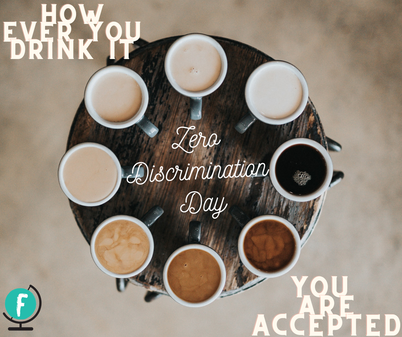 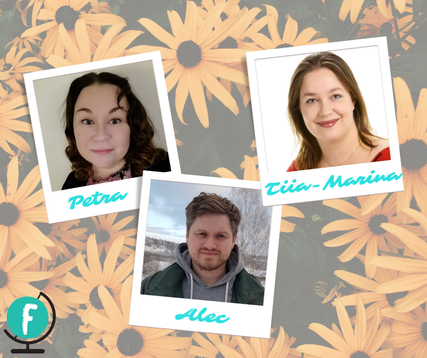 Today Finland celebrates Kalevala's Day. It's a day to remember a great Epic of Kalevala by Elias Lönnrot. This day is also known by some as the Finnish Culture Day. I decided to talk to my 6-year-old son about the Sampo, which was a Magical artefact constructed by Ilmarinen in Kalevala, and it brought riches and good fortune to its holder. I asked my son what he wanted if he had the Sampo and he answered sugar for sweet, salt so my food would be tasty and crystals because they are so beautiful. He asked me what I would have wished for, and I really wasn't sure for a while, so he said "Äiti, you always say that all you wish for is love and peace!" It made me realise that I actually didn't want any material fortunes. I want safer world, filled with love and respect. And this reminded me of 3 wonderful individuals that are inspiring exactly that.
Tiia-Marina has been with Familia more than 10 years, when she first joined as a trainee when she has decided to follow her heart to the social field. She describes Familia as a wonderful place where intercultural families, like hers, found activities, opportunities to meet other intercultural families who they shared similarities with. Tiia-Marina describes the Finnish culture as "a challenging culture for many foreigners to understand", and that Familia offers help and guidance to ease their bureaucratic frustrations. She mentions the colourful olden days where people walking in and out of the premises, cooking, and socialising. Tiia-Marina, explains how Familia's services are needed in present and future of intercultural families. The relationship counselling that Familia offers is very important to both sides, the foreign and Finnish part of the family she clarifies. She describes the problems of immigrants and intercultural families as familiar to her as the back of her hand. Her personal difficult experiences made it clear to her how important it is to receive that support. Tiia-Marina also talks of multilingualism and how it is the child's right to have their other languages supported, acknowledged and respected. She wishes for Familia to bring even more activities in the future to support intercultural families and all who moves to Finland.
Alec sees also the importance in the work and what Familia is offering from various range of services. He describes how Familia is assisting intercultural families to navigate a complex environment. Alec is very proud to offer his time and service to an NGO that is offering tools and a voice for many intercultural families in Finland, and hopes to continue supporting in all ways possible for the inspirational staff and volunteers at Familia. Alec describes Familia as vital for health of society and the promotion of intercultural dialogue. He believes that Familia will improve the integration of immigrants and advocates on their behalf for better polices, through their works. He worries how in the recent years we have seen the revival of populism and anti-immigrant rhetoric, which he believes is mostly due a misguided fear of the "other". He thinks that Familia and other NGOs with similar minds and way will be a great assed to tackle this issue head on.
Petra describes Familia work as important and close to her heart. She has been with Familia for 4 years and ever since has found out that Familia shares the same values with her and so it has been a key factor in her involvement with Familia. Petra believes in giving back to the community, so she finds it important to volunteer in NGOs such as Familia. Petra also tells that she is happy to have a is a part of a place where her experience has been found useful and could be used in helping others. In Petra's view Finland is changing, intercultural families and immigrants are increasing, so Familia is needed to be involved in this change and support the those who have moved here. Petra also believes that NGOs will benefit from identifying challenges and opportunities in the communities through research, surveys, and other analyses. Then this valuable knowledge can be used to build a new common good through constructive projects and developments. So if we think about it and imagine a world filled with such selfless people we would be able to see how wonderful the world would be. So yes... Maybe I would wish for unending production of people that are filled with love, selflessness and desire to change the world for everyone to live in peace and feel accepted.  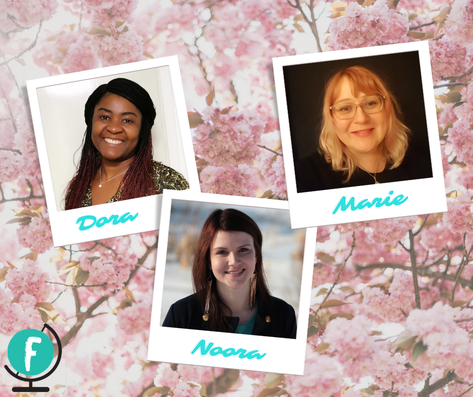 Each year World NGO Day is celebrated on February 27th. NGOs have a history that dates to at least the late 18th century, they have always been at the forefront of social movements and changes. Personally, I became active in the NGO world in Finland just few years back, but today we are not talking about me. We are talking about three very inspiring people that are part of Familia's board of directors.
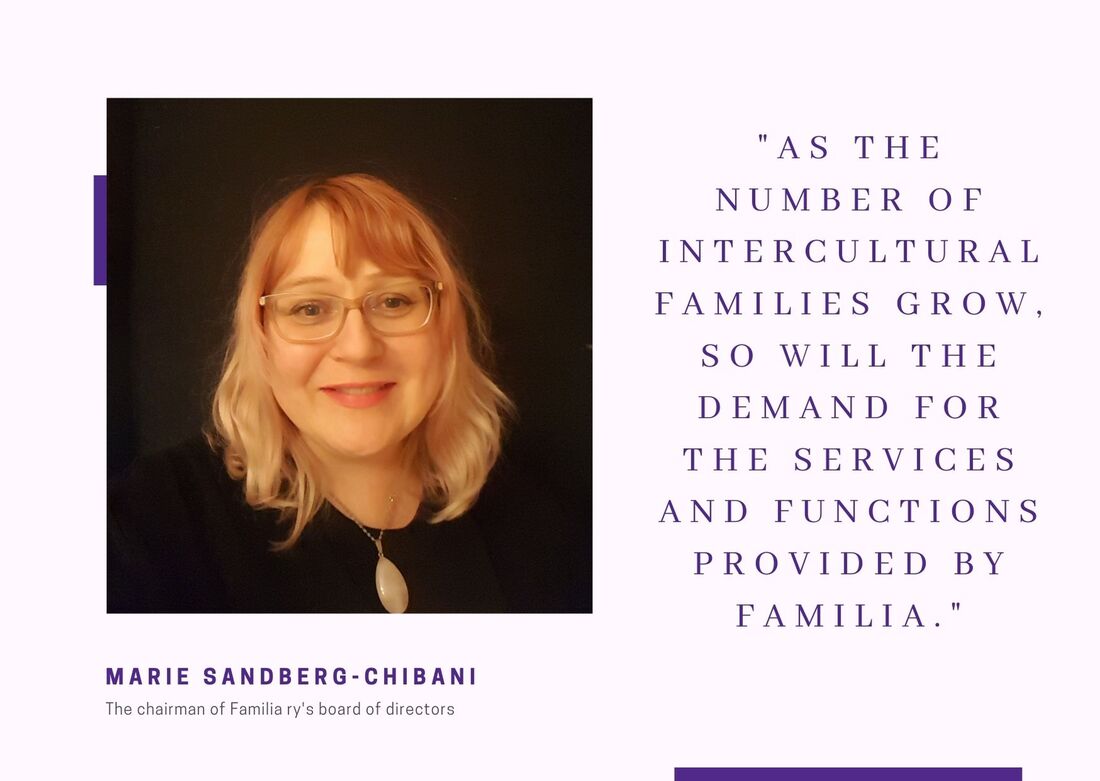
Marie has been part of Familia for over 20 years, started as a volunteer and today she is the chairman of the board of directors. She describes how Familia has evolved and grew in those years. For Marie Familia is very important due to its objectives. She explains how the support of intercultural families is a personal matter to her and it has been very beneficial. She calls Familia as her "other partner" that has been in her life for many years. Marie believes that because the intercultural families are only growing in Finland, so it is a very important to have such organisation that supports and helps them. "As the intercultural families grow, so will the demand for the services and functions provided by Familia." that is how Marie explains the reason why she will be still around as a supporter to Familia in years to come.
Noora sees Familia as an active social debater that tackles issues and subjects, which are very important in intercultural families' daily lives. She describes this being close to her own heart, because she faces those matters in her own daily life in an intercultural and bilingual family. She expresses her appreciation to all the work that is done by Familia to support multicultural family lives like hers. Noora says that NGOs such as Familia are shaping the future and making the change for the better, through discussions and raising social advocacy. Additionally to that she says that Familia is doing so much good through the language courses, relationship support and parental coaching that Familia is offering. In Noora's opinion Familia is an important NGO for present and future for the increasing numbers of intercultural families.
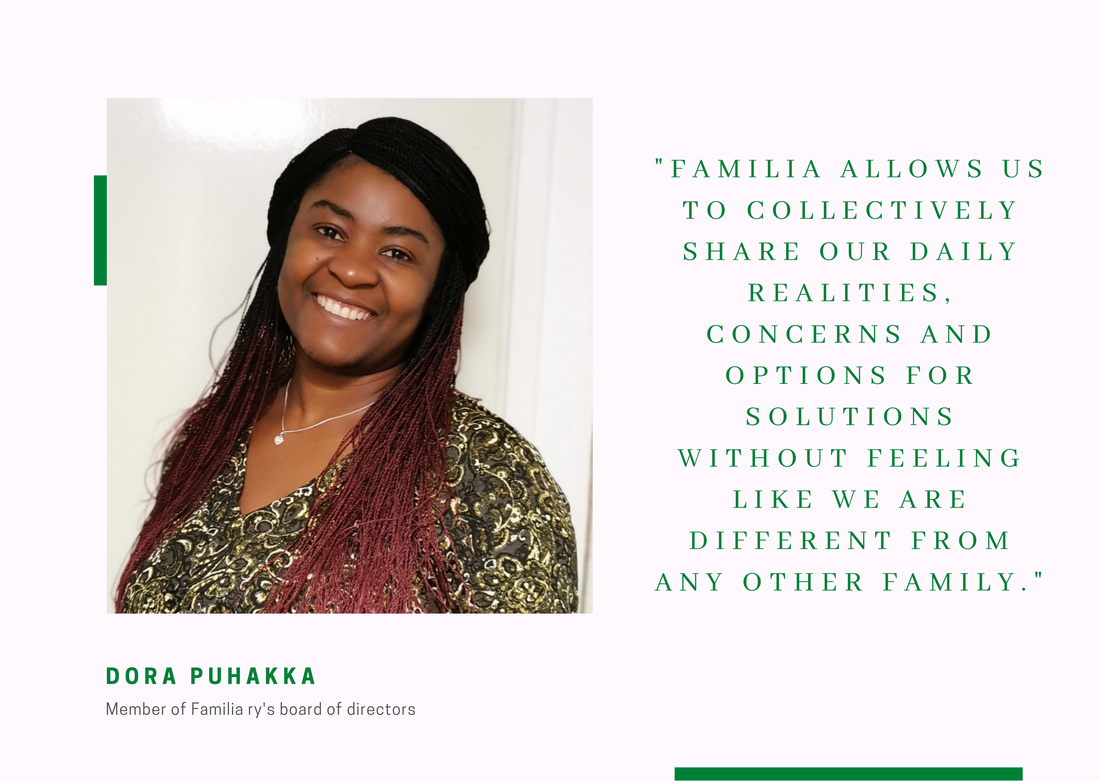
Dora has been introduced to Familia over 10 years ago through a peer support group, and she has since then been a part of the activities that support intercultural families like hers. She enjoys being a part and surrounded by other people from intercultural families, as they collectively share their daily realities, concerns and options for solutions without feeling like they are different from any other families. Dora describes Familia as a provider of a platform for intercultural families' voice's in our society to be represented and heard nation wide. Dora believes that Familia has a very long list of great things that it could bring to the future of intercultural life in Finland. The most important things in her opinion are the wider networks, a better sense of belonging, new perspectives, more understanding, enlightenment, and in-depth solutions for challenges that intercultural families and the multicultural Finland require. Those three lovely people have been an inspiration to many. They spend a lot of their own personal free time trying to support an NGO like Familia in every way possible, just in hope for a better life for the present and the future of intercultural generations.
Happy World NGO day to all NGOs, volunteers, donors and workers who are trying to change the world one step at a time!  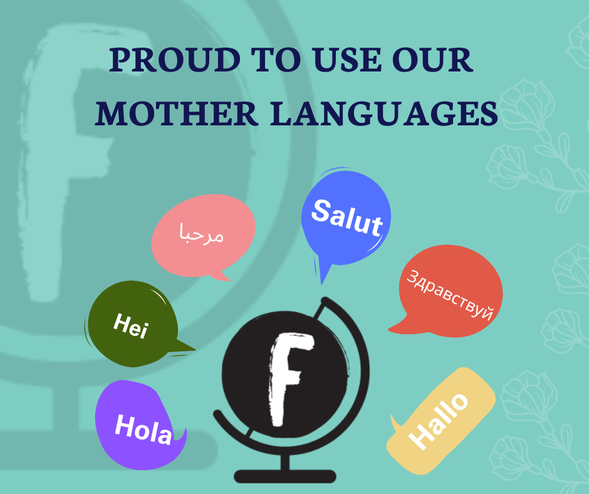 On 21st of February countries around the world celebrate the mother language or the mother tongue. Here at Familia we celebrate it with mix of mother tongues. This multilingual staff working under one roof have brought to our beloved organisation even a greater value. For years I was confused how to define mother tongue. I spoke only Finnish until I was 6 years old, after that I moved away from Finland and spoke Arabic and English until I was 22 years old, when I moved back to Finland. I was asked to put down on an official paper my mother tongue, I had by then 3.
People of minority languages in Finland also suffer, they don't find enough support for their mother tongues. Having another language beside the Finnish language will not make the person any less knowledgeable in Finnish. My 6-year-old son lives in a multilingual surrounding, I speak to him in Arabic, his father speaks to him in Persian, his sister speaks to him in English and his grandmother, aunt and other family members speak to him in Finnish. Also he has been in a Finnish day-care since the age of 3. So this made him English/Finnish speaker. I find those two languages are totally equal in strength in his mind. I came to apply for his first year at school to find out that after over 20 years Finnish authorities still don't allow more than one mother tongue. When will this change?
So in what language do you feel? Can you dig inside and find out? I personally feel in both Arabic and English and so my mother tongues are English and Arabic! And I should have the right to be registered as bilingual mother tongue!
|
blogi - blogAjatuksia ja kokemuksia elämästä kahden kulttuurin keskellä.
Reflections and experiences from the life of intercultural families. kategoriat
All
osallistuToivotamme sinut lämpimästi tervetulleeksi osallistumaan blogiyhteisöömme: lue, kommentoi ja kirjoita!
Kirjoittajina voivat toimia kaikki kahden kulttuurin arkea elävät ja aiheesta kiinnostuneet. Kynnystä kirjoittamiselle ei tule nostaa liian korkealle ja kirjoittaa voi joko omalla nimellä tai nimimerkillä. Blogissa esitetyt näkökannat ja mielipiteet ovat kirjoittajien omia, eivätkä edusta Familian kantaa. Kahden kulttuurin arki on itsessään kiinnostavaa ja siitä kirjoittaminen voi avata myös itselle uusia näkökulmia! Blogikirjoituksia voi tarjota sähköpostitse (info@ familiary.fi) tai yhteydenottolomakkeen kautta. Lopullisen valinnan julkaistavista jutuista tekee Familian henkilökunta. Tervetuloa mukaan! participate!We warmly welcome you to participate in our blog community: read, comment, and write!
Anyone who lives and works in the world of intercultural families and is interested in the topic is welcome to contribute. The threshold for writing should not be too high, and you can write either under your own name or under a pseudonym. Keep in mind that the views and opinions expressed in the blog are those of the authors and do not represent the position of Familia. The everyday life of intercultural families is interesting and writing about it can also open new perspectives for you! Your story matters and helps to raise awareness about the opportunities and challenges within intercultural families. Blog contributions can be submitted by e-mail (info@ familiary.fi) or via our contact form. Final selection and edition of the stories to be published will be conducted by our staff. Welcome to join us! |
 RSS Feed
|
|

|
Familia on johtava kahden kulttuurin perheiden asiantuntija ja edunvalvoja Familia is the leading expert and advocate of intercultural families |
|
© Familia 2024